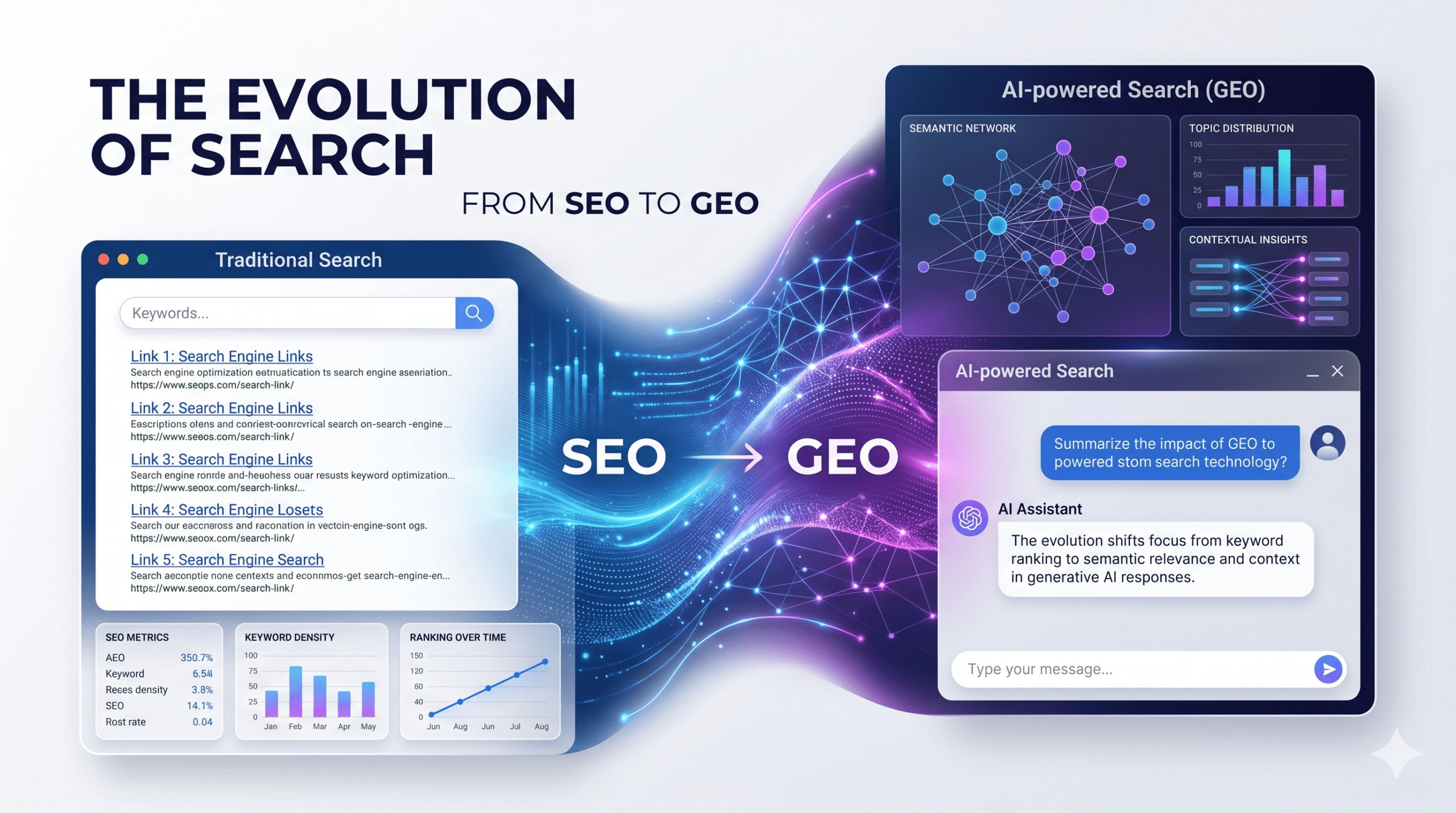
If you’ve spent any time looking at your website’s organic traffic analytics recently, you’ve likely noticed a shift. The era of users blindly clicking through the “10 blue links” is fading. Today, users ask a question, and an AI search engine reads the internet, synthesizes the facts, and hands them a complete answer.
According to a much-cited prediction by Gartner, traditional search engine volume is expected to drop by 25% by 2026 as users migrate to AI chatbots and virtual agents.
For over 15 years, digital marketers have relied on Search Engine Optimization (SEO) to win traffic. But as platforms like ChatGPT Search, Perplexity AI, and Google’s AI Overviews take center stage, the playbook has changed. Welcome to the era of Generative Engine Optimization (GEO).
Is GEO replacing SEO? Which one should you prioritize? In this in-depth guide, we’ll strip away the jargon, look at the hard data, and explore the exact differences in the SEO vs GEO debate—and how you can leverage both to make your brand inescapable in 2026.
Key Concepts Explained
To understand how to win in today’s search landscape, we must first clearly define the two battlegrounds.
What is SEO (Search Engine Optimization)?
Search Engine Optimization is the traditional practice of improving a website to increase its visibility on search engines like Google, Bing, and Yahoo.

Traditional search engines are essentially massive librarians. They use bots to crawl your website, index your pages, and apply complex algorithms (weighing factors like backlinks, keyword relevance, and page speed) to rank your content. The ultimate goal of SEO is to land on Page 1, earn a click, and drive a user to your website.
What is GEO (Generative Engine Optimization)?
Generative Engine Optimization is the specialized practice of optimizing your content so that Large Language Models (LLMs) and AI-powered search engines (like ChatGPT, Claude, and Perplexity) select, summarize, and cite your brand in their generated responses.
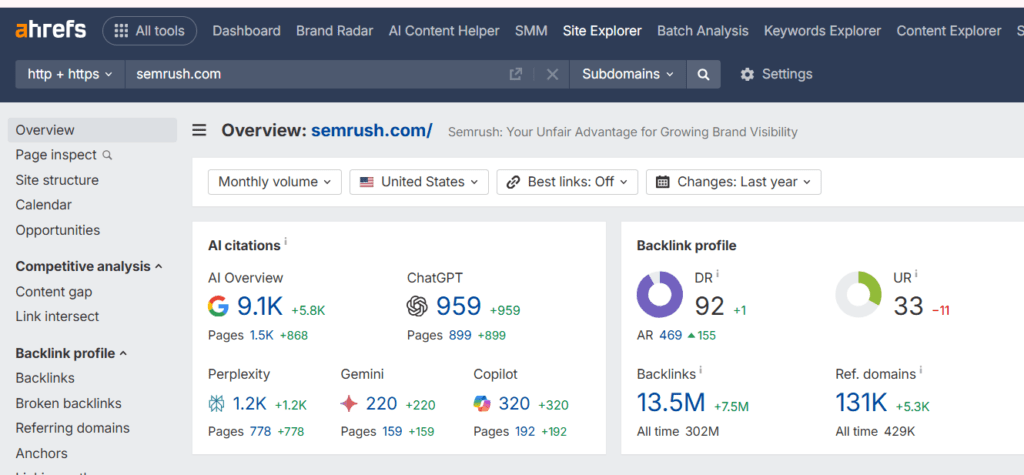
Unlike traditional search engines, generative engines don’t just list URLs. They interpret the user’s intent, retrieve information from trusted data sources, synthesize those facts, and write a custom, multimodal response. With GEO, your goal is no longer just to rank on a page; your goal is to be the authoritative source the AI cites to build its answer.
Deep Dive: Key Differences in SEO vs GEO
While both disciplines aim to increase your digital visibility, their mechanics, focus, and end goals differ fundamentally.
Target Platforms
SEO: Focuses on traditional algorithmic search engines (Google Search, Bing).
GEO: Focuses on AI-driven conversational engines and search features (ChatGPT, Perplexity, Microsoft Copilot, Google AI Overviews).
The Mechanics of “Ranking”
In SEO, you optimize for crawlability. You want the bot to see your keywords, follow your internal links, and register your high-authority backlinks. In GEO, you optimize for information extraction. AI models process content in “chunks” or segments. They are looking for factual density, contextual relevance, and entity authority (how well-known your brand or author is across the entire web, not just on your site).
Content Structure and Format
For years, SEO rewarded long-form content. If you wanted to rank for “how to fix a leaky faucet,” you might write a 2,000-word article detailing the history of plumbing before getting to the answer. GEO actively penalizes fluff. Generative engines favor an “Answer-First” structure. They look for clear H2 and H3 headings followed immediately by concise, definitive answers, bullet points, and data sets that are easy for a machine to parse and quote.
Traffic vs. Visibility
The hardest pill for traditional marketers to swallow is the metric shift. SEO is designed to generate clicks and traffic. GEO often results in zero-click searches—the user gets their answer directly from the AI and leaves. Therefore, GEO metrics focus on brand mentions, citations, and visibility share within AI outputs rather than raw website sessions.
| Feature | Traditional SEO | Generative Engine Optimization (GEO) |
| Primary Goal | Drive clicks and direct website traffic. | Be cited as the trusted source in AI answers. |
| Output Type | A ranked list of links to webpages. | A single, synthesized, conversational answer. |
| Key Ranking Factors | Backlinks, keyword density, technical site health. | Factual density, original data, semantic structure, entity authority. |
| Content Preference | Comprehensive, long-form guides. | Concise, highly extractable, “answer-first” chunks. |
| Success Metrics | Organic traffic, Click-Through Rate (CTR), SERP position. | AI citations, brand impressions in prompts, conversational conversions. |
The Data Behind GEO: What the Research Actually Says
If you think GEO is just another marketing buzzword, the data suggests otherwise.
The term “Generative Engine Optimization” was formally introduced to the world in a landmark research paper presented at the KDD 2024 conference by researchers from Princeton University, Georgia Tech, and the Allen Institute for AI.
The researchers tested 10,000 queries across multiple generative engines and evaluated different content optimization strategies. Their findings completely disrupted traditional SEO logic:
- Data is the Ultimate Hack: The study found that adding specific, verifiable statistics and quoting authoritative sources increased a page’s visibility in AI-generated responses by up to 40%. Vague claims are ignored by LLMs; hard numbers are synthesized.
- The Playing Field is Leveled: In traditional SEO, the top 3 ranking domains usually monopolize the traffic. However, the Princeton study revealed that websites ranking lower in traditional search (e.g., position 5) experienced up to a 115% increase in AI visibility when GEO tactics were applied. Sites already at position 1 saw minimal changes.
What does this mean for you? It means GEO is the ultimate equalizer. Even if you lack the domain authority to outrank a giant competitor on Google, you can out-optimize them for AI citations by making your content more factual and machine-readable
Common Mistakes and Myths in 2026
Myth 1: “GEO will replace SEO.”
Reality: When analyzing SEO vs GEO, the most dangerous myth is that one will replace the other. Search journeys are diversifying, not consolidating. A user might use Perplexity to research software options (GEO), but then use Google to find the specific pricing page or read customer reviews (SEO). To win, you need an integrated strategy. SEO gets you found; GEO gets you trusted.
Myth 2: “AI likes robotic, keyword-stuffed content.”
Reality: Generative engines are trained on natural human language. They favor conversational, highly readable content over rigid keyword stuffing. Semantic richness—using naturally related terms rather than repeating the same primary keyword—is far more effective.
Myth 3: “My website content is the only thing that matters.”
Reality: AI engines cross-reference facts. If your website claims you are the “Best CRM Software,” but Reddit threads, G2 reviews, and industry forums don’t echo that claim, the AI won’t cite you. Off-page entity authority (Digital PR, reviews, mentions) is a massive driver of GEO.
Practical Playbook: How to Optimize for Both
As an SEO professional who has audited hundreds of sites, I can tell you that the best strategy doesn’t treat SEO and GEO as enemies. They share a technical foundation. Here is how you can adapt your strategy to win in both arenas.
1. Adopt the “Answer-First” (or BLUF) Content Structure
BLUF stands for “Bottom Line Up Front.” AI engines break content into passages to evaluate relevance.
- Action: When writing an H2 (e.g., “What is a backlink?”), do not start the following paragraph with a story. Answer the question directly and comprehensively in the first 40 to 60 words. Once the definition is established, use the rest of the section to provide context and examples.
2. Prioritize Factual Density Over Word Count
AI tools are desperate for original data to build their answers.
- Action: Stop writing generic think-pieces. Publish original surveys, case studies, and proprietary data. Instead of saying, “Many companies use AI,” say, “According to our 2026 survey of 500 marketers, 68% use AI for content creation.” You will become the cited source.
3. Implement Deep Structured Data (Schema Markup)
You have to help the machines understand your content. Schema markup translates your text into the language of search engines.
- Action: Go beyond basic website schema. Implement FAQPage, Article, HowTo, and Organizatio markup. If you have an FAQ section, marking it up with schema explicitly tells the AI, “Here is a question, and here is the exact answer.”
4. Build Entity Authority Off-Site
AI doesn’t inherently trust your marketing copy; it trusts consensus.
- Action: Invest in Digital PR. Earn mentions on credible trade publications, participate authentically in Reddit communities, and build up third-party reviews. When a user asks an AI for a recommendation, the AI pulls from this collective internet consensus.
5. Target High-Intent, Nuanced Queries
Because AI handles basic informational queries easily (resulting in zero-click searches), your organic traffic strategy needs to shift toward bottom-of-the-funnel intent.
- Action: Stop wasting budget trying to rank for broad terms like “What is CRM?” Instead, target complex, commercial queries like “Best CRM for 50-person B2B sales teams using HubSpot.” AI handles the “what is,” but human buyers still want expert breakdowns for the “which one should I buy.”
Conclusion
The transition from search engines to answer engines is well underway. While SEO built the foundation of the digital web by connecting users to links, GEO is building the future by connecting users to synthesized knowledge.
You don’t have to choose between the two. The true answer to SEO vs GEO is integration. The brands that will dominate 2026 and beyond are the ones that maintain technical SEO excellence while upgrading their content to be factual, highly structured, and easily citable by AI. Optimize for the human reading the screen, structure for the machine generating the answer, and your visibility will thrive regardless of which engine the user chooses.