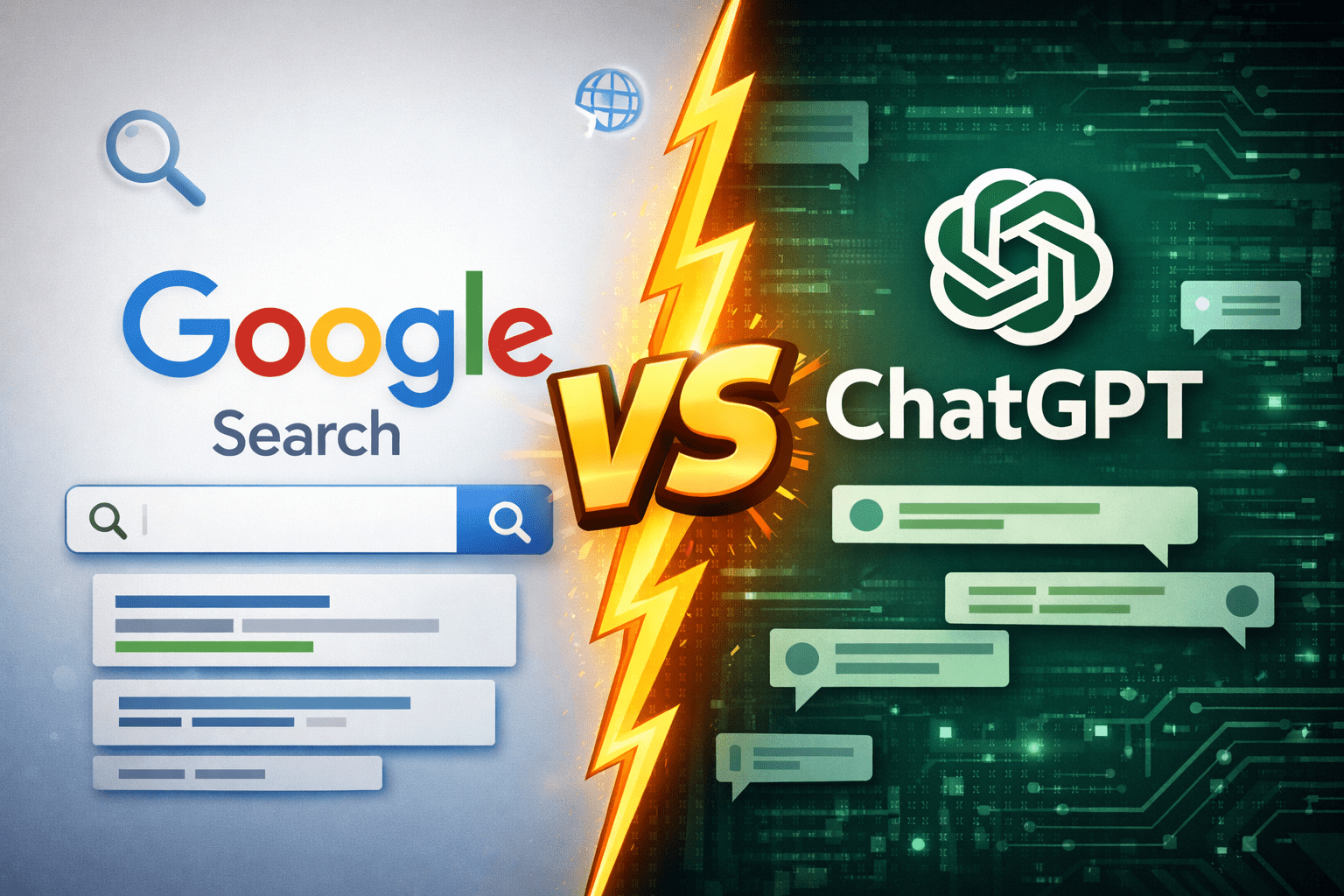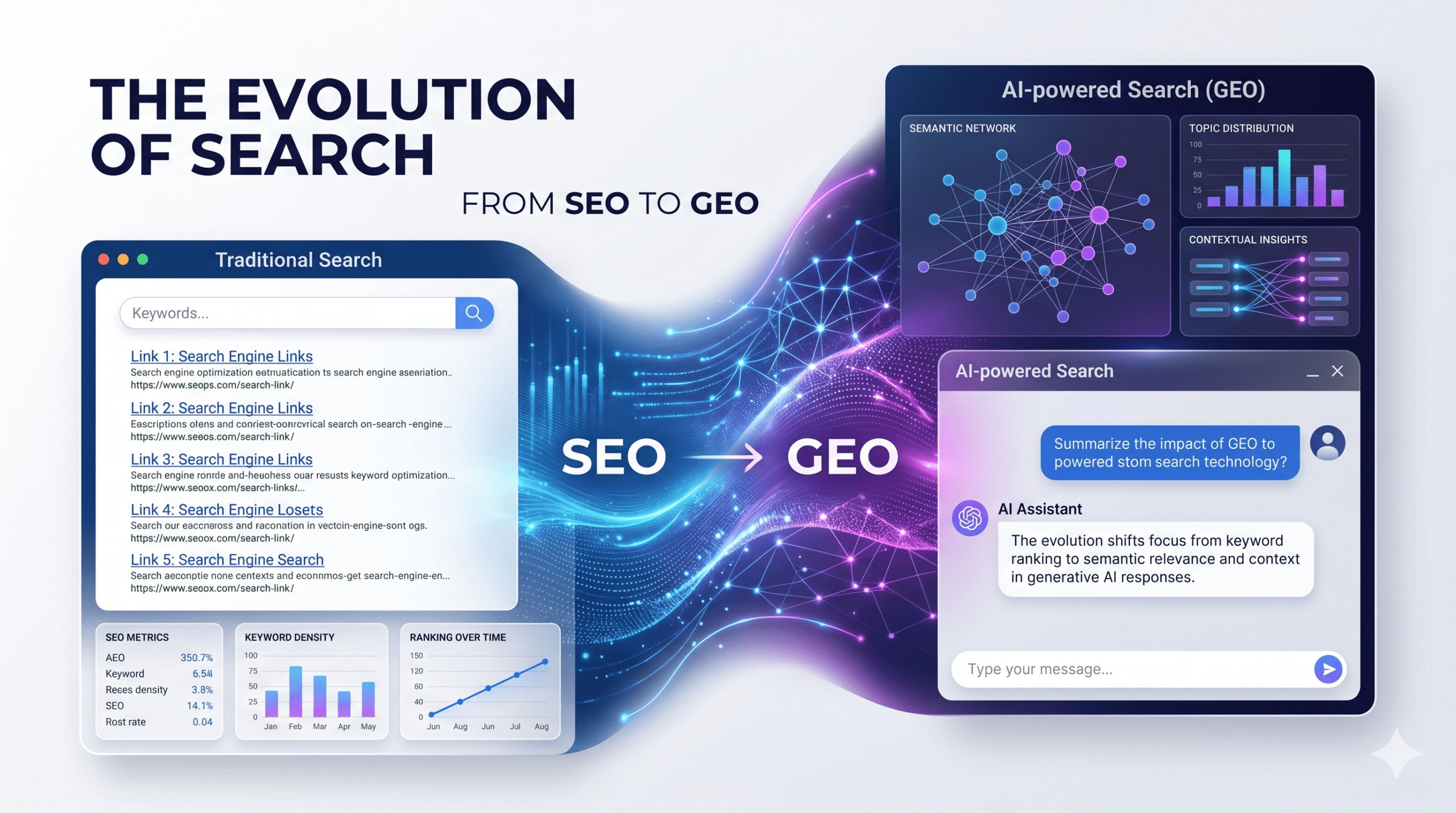
The search landscape is currently experiencing its most volatile transformation since the birth of the Google algorithm. For over two decades, SEO was a game of visibility—climbing a ladder of “10 blue links” to capture a click. Today, that ladder is being replaced by a stage. On this stage, AI engines like SearchGPT, Perplexity, and Google Gemini don’t just point users toward information; they synthesize it into a single, authoritative response.
If your content isn’t part of that response, it effectively doesn’t exist for a growing segment of users.
This is the era of Generative Engine Optimization (GEO). It is no longer enough to “rank.” You must be “cited.” This article provides a deep dive into the mechanics of AI search and an actionable roadmap for future-proofing your digital presence.
1. Understanding the Core Concepts: From SEO to GEO
To win in AI search, we must first understand how Large Language Models (LLMs) differ from traditional crawlers.
Traditional search engines (like Google 1.0) use a “retrieve and rank” model based on keywords and backlinks. Modern AI engines use Retrieval-Augmented Generation (RAG). They browse the web, select a handful of highly relevant documents, and “extract” the truth to build a comprehensive answer.
Key Terminology:
- GEO (Generative Engine Optimization): The practice of optimizing content specifically to be included in generative AI summaries and citations.
- AEO (Answer Engine Optimization): A subset of SEO focused on providing direct, concise answers to specific user questions.
- Semantic Completeness: The ability of a piece of content to answer a user’s core question and all likely follow-up questions within a single page.
Example: If a user asks, “What is the best CRM for a mid-sized B2B tech company?”, a traditional search result gives you five lists of CRMs. An AI engine provides a recommendation of three specific CRMs, explains why based on pricing and integration, and cites the sources it used to make that judgment.
2. The Seven Pillars of AI Search Ranking Factors
Recent data from industry-leading studies (including the landmark KDD 2024 paper from Princeton and Georgia Tech researchers) highlights that AI engines prioritize different signals than traditional SERPs.
I. Factual Density & Verifiability
AI models are prone to “hallucinations,” which makes them incredibly sensitive to factual accuracy. The Princeton study found that adding statistics and verifiable data to content increased its probability of being cited by 37%.
- The Rule: Every major claim should be backed by a cited statistic or a link to a primary source (e.g., “The average B2B conversion rate is 2.23% (Source: HubSpot 2024)”).
II. Semantic Completeness (The r=0.87 Factor)
Research shows a high correlation (r=0.87) between “semantic completeness” and AI selection. This means the engine prefers sources that provide a “one-stop-shop” answer. If your article on “How to Bake Sourdough” omits the ideal humidity levels, an AI engine might skip it in favor of a competitor who covers the entire environment.
III. The “Answer-First” Architecture
AI models scan content for “extractable units.” To cater to this, adopt the inverted pyramid style of journalism.
- H2: “How does AI search optimization work?”
- First Sentence: “AI search optimization works by structuring content into semantically clear, data-rich segments that LLMs can easily retrieve and cite.”
- Following Sentences: Expand on the technical details.
IV. Multi-Modal Integration
In 2025, Google’s AI Overviews increasingly favor multi-modal content. Pages that combine text with original diagrams, structured data, and short-form video see a 156% higher selection rate for AI summaries.
V. Entity-Based Authority (E-E-A-T)
AI doesn’t just look at your website; it looks at your entity. Are you mentioned on Reddit? Do you have a Wikipedia or Wikidata entry? Are your authors cited on other authoritative sites? LLMs build a knowledge graph of your brand. Consistency across the web—from LinkedIn to industry directories—is now a ranking signal.
3. Platform Deep-Dive: SearchGPT vs. Perplexity vs. Gemini
Optimizing for “AI” is not a monolith. Each engine has a unique “personality” and preference for sources.
| Platform | Primary Preference | Key Ranking Signal |
| SearchGPT / ChatGPT | Authoritative lists & Cross-platform mentions | Mentions in the “Top 5-10” traditional search results. |
| Perplexity AI | Recent data & User-Generated Content | Heavy reliance on Reddit (46.5% of citations) and YouTube. |
| Google Gemini / SGE | High E-E-A-T & Proprietary Data | Official Google documentation, Wikipedia, and High-DR blogs. |
Optimizing for Perplexity: Perplexity thrives on “freshness.” If you are in a fast-moving industry (Tech, Finance, Health), updating your content with current dates and real-time news links is the most effective way to jump into their citation box.
Optimizing for SearchGPT:
SearchGPT focuses on “consensus.” It scans multiple sources to see which brands are consistently recommended. To rank here, you need Off-Page GEO: getting mentioned in listicles, review sites, and press releases.
4. Technical GEO: The New SEO Baseline
Traditional technical SEO (speed, mobile-friendliness) is still the foundation, but GEO adds a layer of Machine Readability.
1. Advanced Schema Markup (JSON-LD)
Think of Schema as the “cheat sheet” for the LLM. While Google uses it for Rich Snippets, AI engines use it to understand relationships.
- Use
FAQPageSchema: For every H2 that is a question. - Use
AuthorSchema: To link your content to the author’s social profiles and professional credentials, reinforcing E-E-A-T. - Use
AboutandMentionsSchema: To tell the AI exactly which entities (products, brands, concepts) your page is about.
2. Citation-Ready Phrasing
AI models often “lift” sentences directly. Avoid fluff like “In today’s fast-paced world…” and use “Standalone Claims.”
- Bad: “Many people think that SEO is changing, and it’s quite a fast shift.”
- Good: “SEO is evolving into GEO, a shift driven by the rise of Retrieval-Augmented Generation (RAG) in search engines like ChatGPT.”
5. Real-World Applications & Data
The Princeton Study Findings (2024)
The study tested various optimization strategies on a set of 10,000 queries. The most effective “boosters” for visibility were:
- Citations & References: Including high-quality external links (+40% boost).
- Quotations from Experts: Adding unique, authoritative quotes (+25% boost).
- Statistics: Including numerical data (+37% boost).
Case Study: The “Entity” Strategy
A boutique design agency was struggling to rank for “Top B2B Design Trends.” They pivoted from a keyword strategy to an Entity Strategy. They:
- Updated their Google Business Profile and LinkedIn to use identical “About” descriptions.
- Published a proprietary “State of Design 2025” report with 15 unique statistics.
- Answered 10 specific questions on Reddit and Quora about design trends. The Result: Within 6 weeks, the brand was cited as the primary source in Perplexity and SearchGPT for trends-related queries, despite not being #1 on traditional Google SERPs.
6. Common Myths & Mistakes
- Myth 1: “SEO is Dead.”
- Reality: SEO isn’t dead; it’s being “absorbed.” Traditional ranking signals still determine which documents the AI “retrieves” before it “generates” an answer.
- Myth 2: “AI-Generated Content is Best for AI Search.”
- Reality: AI engines prioritize unique insight. If your content is just a rehash of what the AI already knows, it has no reason to cite you. It looks for “Information Gain”—new data, new perspectives, or original research.
- Myth 3: “Word Count Matters.”
- Reality: AI engines favor Information Density. A 500-word article packed with facts and structured data will outperform a 3,000-word article filled with fluff.
7. Practical Tips: Your GEO Action Plan
- Audit for “Information Gain”: Ask yourself: “Does this page provide data or a perspective that doesn’t exist anywhere else?”
- The 200-Word Rule: Ensure the first 200 words of your page provide a direct answer to the primary query.
- Claim Your Entity: Ensure your brand name, address, and core services are identical across all social and directory platforms.
- Incorporate “Trust Anchors”: Use bylines for expert authors, include “Last Updated” dates, and link to high-authority peer-reviewed studies.
- Monitor “AI Share of Voice”: Use tools like BrightEdge or Share of Model to track how often your brand is mentioned in AI-generated answers compared to your competitors.
Conclusion: The New Gold Standard
The shift toward AI search optimization is a shift toward quality, clarity, and authority. In the old world, you could “trick” an engine with enough backlinks and keywords. In the AI world, you must actually be the expert.
By focusing on semantic completeness, factual density, and technical machine-readability, you don’t just survive the AI revolution—you lead it. The goal is no longer to be the first link on the page; it is to be the only answer the user needs.